Garden design and landscaping in Buckinghamshire should create something that belongs to your home, your garden and the way you want to live in it.
Your finished garden does not need to resemble the one next door, follow the latest fashion or reproduce something you have already seen online, because the whole point of commissioning a professional garden designer is to discover what your own space could become.
Over the years, we have designed and built gardens throughout Amersham, Chalfont St Giles, Gerrards Cross, Beaconsfield, Seer Green and the surrounding Chilterns. Although every project has been different, most clients begin in much the same place: they know their existing garden is not working as well as it should, even if they have not yet decided what the answer looks like.
Some arrive with photographs, sketches and a detailed list of everything they would like to include, while others simply explain what frustrates them about the garden they already have. Both approaches are perfectly useful, because good garden design starts by understanding the problem before we begin drawing the solution.
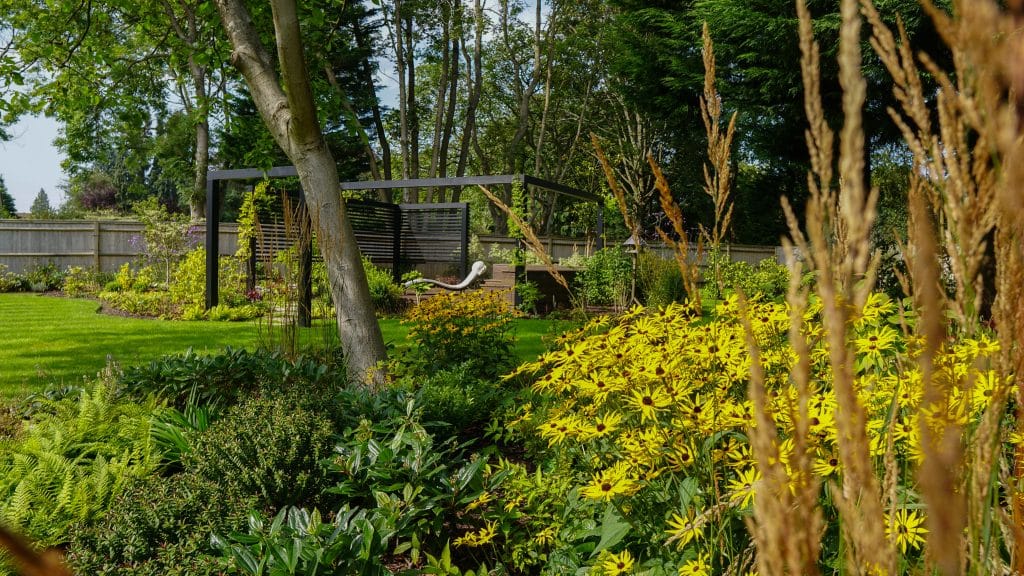
Good garden design begins long before choosing the paving
Beautiful paving, interesting plants, good decking and carefully chosen lighting can all contribute to an exceptional garden, although simply assembling attractive products does not necessarily create one. The design needs to establish how the garden will work first, because those decisions determine whether everything that follows feels considered or merely decorative.
We look at how you move between the house and garden, where you naturally want to sit and what you see through the windows throughout the year. We also consider sunlight, privacy, existing trees, boundaries, changes in level and the relationship between one part of the garden and another, because these factors influence how comfortable the finished space will feel.
Alongside those creative decisions sit the practical matters that professional landscaping cannot ignore. Drainage needs somewhere to go, retaining structures need to work, materials must suit their environment and the construction beneath the finished surfaces needs to perform for many years, rather than simply looking good when the photographs are taken.
Once those fundamentals have been resolved, the more enjoyable details can begin to take shape, and that is usually where an ordinary outdoor space starts becoming somebody’s garden.
An Amersham garden with plenty of space but not enough purpose
A substantial garden can appear to offer endless possibilities, yet more space does not automatically make the design easier. One of our larger projects in Amersham included around half an acre of garden surrounding the property, with both the front and rear requiring a complete rethink rather than a collection of isolated improvements.
The owners wanted more colour and stronger planting, although the real opportunity went considerably further. We needed to establish better relationships between the different areas, improve how people moved through the landscape and make the whole garden feel as though it belonged to one property rather than several disconnected spaces.
New trees and generous planting helped provide structure, while reshaped beds introduced form and movement into areas that had previously felt broad and unresolved. Rather than treating the lawn, planting and circulation separately, the design allowed each element to influence the next, which gave the completed garden a much clearer sense of purpose.
The project subsequently received industry recognition, although the award is not what makes it useful here. It demonstrates how professional garden design can take a property that already possesses plenty of land and create the reason to explore, use and enjoy that land.

An established Tring garden where starting again would have been the wrong answer
The challenge was completely different when we worked on an established garden in Tring, where age and maturity formed part of the character of the property. Some paving had deteriorated, beds had become overgrown and various areas no longer related particularly well to each other, yet removing everything simply because it was old would have thrown away one of the garden’s greatest assets.
Mature gardens possess qualities that newly constructed landscapes need time to acquire. Existing trees, familiar views, proportions and long-established planting can provide a sense of permanence, and a thoughtful redesign should recognise when those elements deserve to remain rather than assuming that transformation requires wholesale clearance.
We therefore retained the character of the setting while changing how the owners experienced it. A sweeping clay-paver path created a more deliberate journey through the garden, reshaped lawn areas gained stronger definition and new planting added colour, texture and seasonal interest without making the finished scheme feel disconnected from what had grown there before.
The result is a garden that feels renewed rather than replaced, which is an important distinction when working with an established landscape. Good design does not always need to announce where the old garden stopped and the new one began; sometimes the better outcome is to make that boundary difficult to find.

Chalfont St Giles, where accessibility became part of the design
Gardens become particularly interesting when several requirements need to work together without any one of them dominating the finished result. At Chalfont St Giles, the design needed to provide attractive entertaining spaces, comfortable movement through the garden and improved accessibility while retaining the relaxed character appropriate to the property.
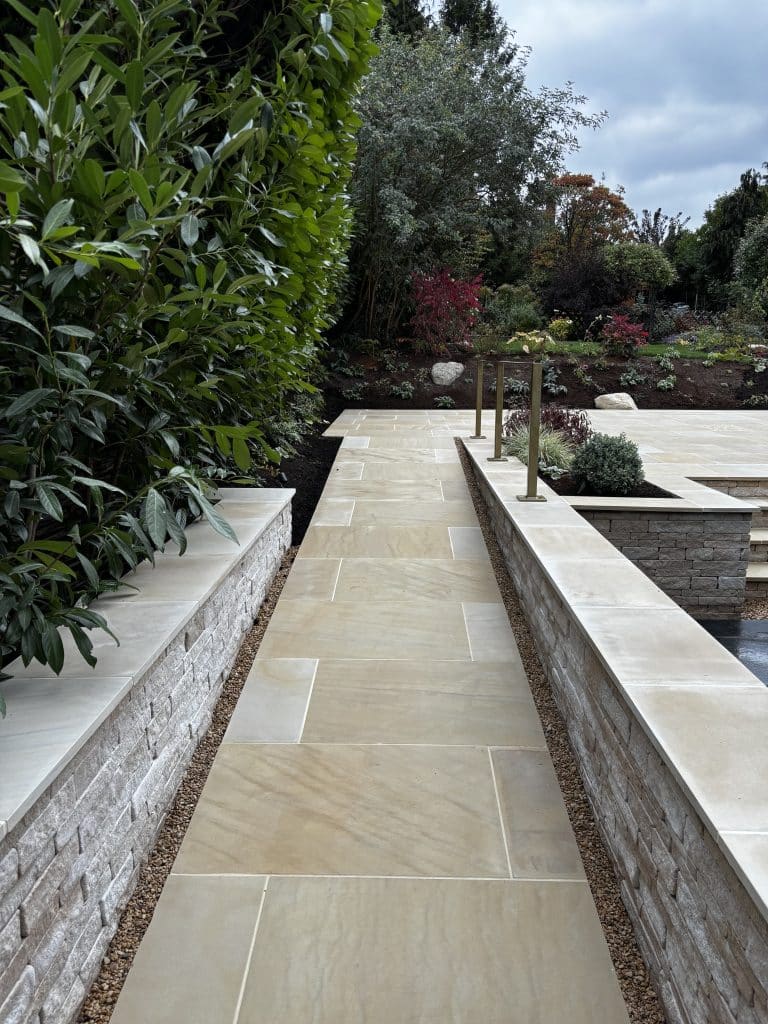
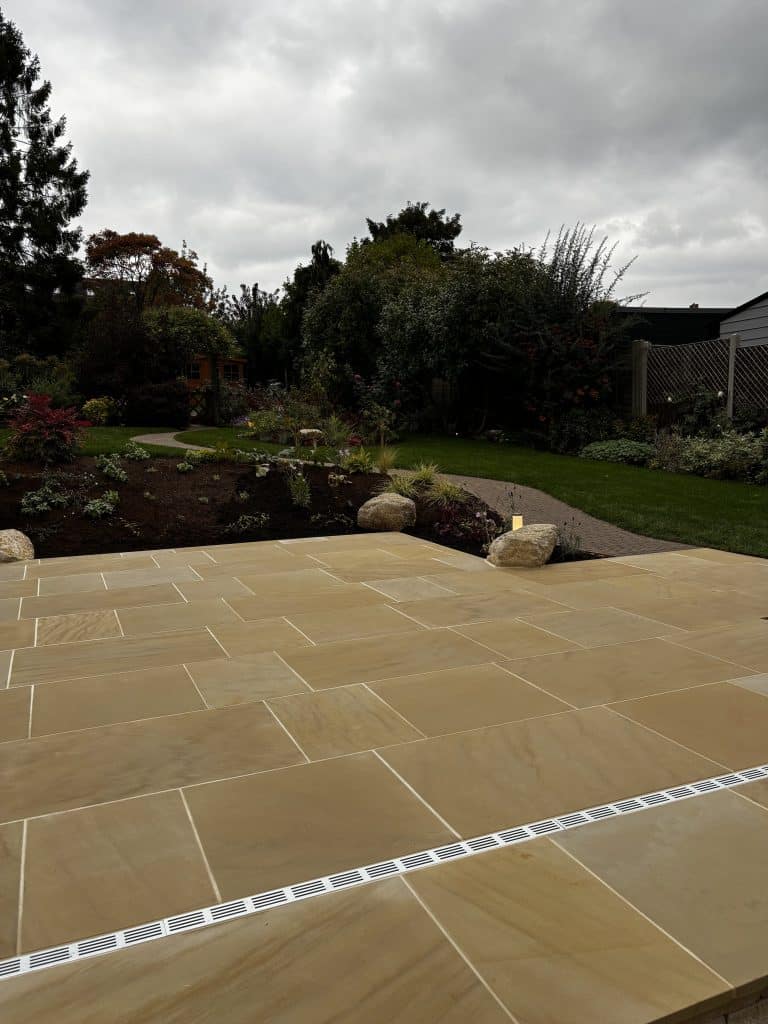
A curved clay-paver path creates movement between the principal areas, while a raised terrace provides a generous destination close to the house. Smooth sandstone gives the terrace a calm architectural quality, and limestone walling, planting, lighting and the surrounding landscape soften the transition into the rest of the garden.
We also incorporated a gentle access ramp into the design, rather than approaching accessibility as something that needed to be added afterwards. When practical requirements form part of the original design thinking, they can become an attractive and almost unnoticed part of the landscape instead of looking like an unfortunate compromise.
Away from the principal terrace, a smaller timber deck creates somewhere quieter to sit and read. The two spaces perform entirely different functions, yet the garden feels coherent because they were designed as parts of the same composition rather than independent features competing for attention.
Seer Green, where a large landscape needed one coherent idea
Large properties create their own design problems because an extensive garden can absorb substantial amounts of construction and planting without necessarily gaining a clear identity. Our Seer Green project extended across more than 2,000 square metres, so the challenge involved much more than filling a large site with features.
The existing mature trees were important to the setting and needed to remain central to the finished landscape. At the same time, the natural levels, family spaces, lawn, drainage and routes through the garden needed to work together so that the property felt generous without becoming fragmented.
Considerable ground engineering sat behind the visible garden, including excavation and new drainage. Those elements mattered enormously during construction, although they should not dominate somebody’s experience when walking through the completed landscape, because successful technical work provides the foundation rather than the focal point.
The trees, open lawn and routes through the site therefore remain the things you notice first. This project operates at a scale beyond most domestic gardens, yet the underlying design principle applies just as strongly to a modest plot in Amersham: solve the technical problems properly, then allow the landscape itself to take the credit.
A small Chesham Bois garden where every decision had to earn its place
Smaller gardens demand just as much thought as large ones, and sometimes considerably more, because there is very little space available to disguise a poor decision. A side garden in Chesham Bois provided an excellent example, as the area could be seen from inside the house but had historically behaved more like an awkward passage than somewhere worth looking at or spending time within.
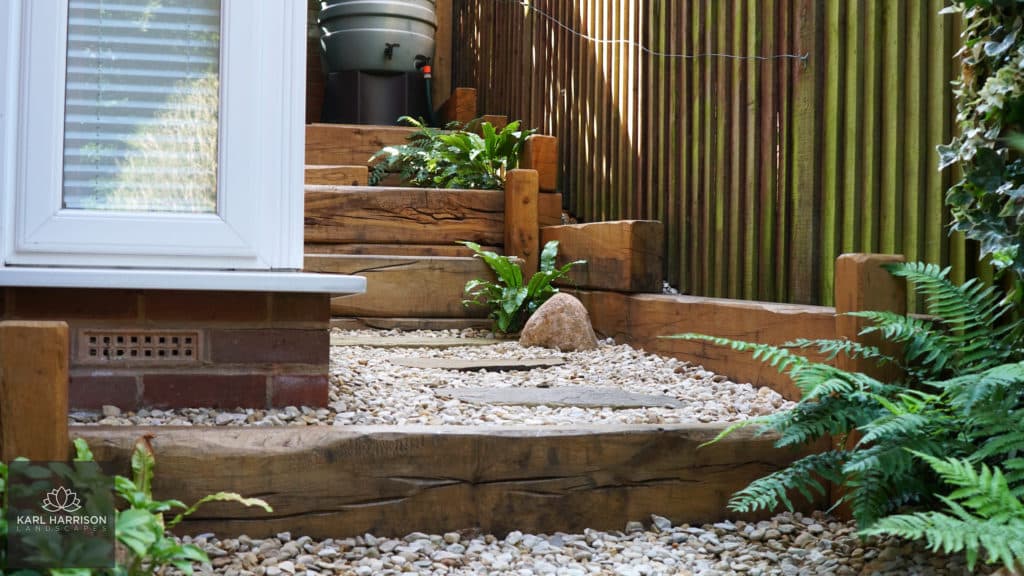
Existing levels, drainage considerations, water storage, boundaries and limited working space all influenced what could sensibly be achieved. Instead of regarding those restrictions as reasons to do very little, we used them as part of the design brief and considered how the space could improve the experience from both inside and outside the house.
French oak sleepers helped resolve the levels, while broken York stone became informal stepping stones through Cotswold shingle and restrained planting. The palette remained deliberately simple because introducing too many materials into a confined garden would have made an already narrow space feel even more complicated.
The transformation did not require the scale of engineering found at Seer Green, nor should it have done. What mattered was recognising that an overlooked piece of garden could become part of the home’s everyday view, which demonstrates why thoughtful garden design is not reserved for large country properties.
Gerrards Cross, where the garden begins before reaching the front door
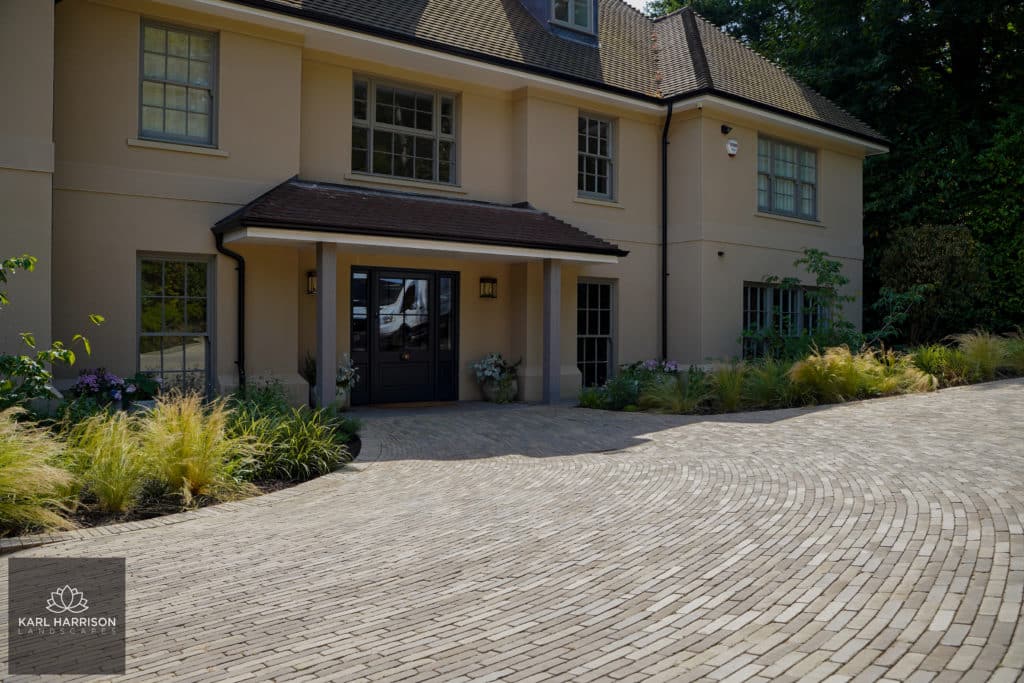
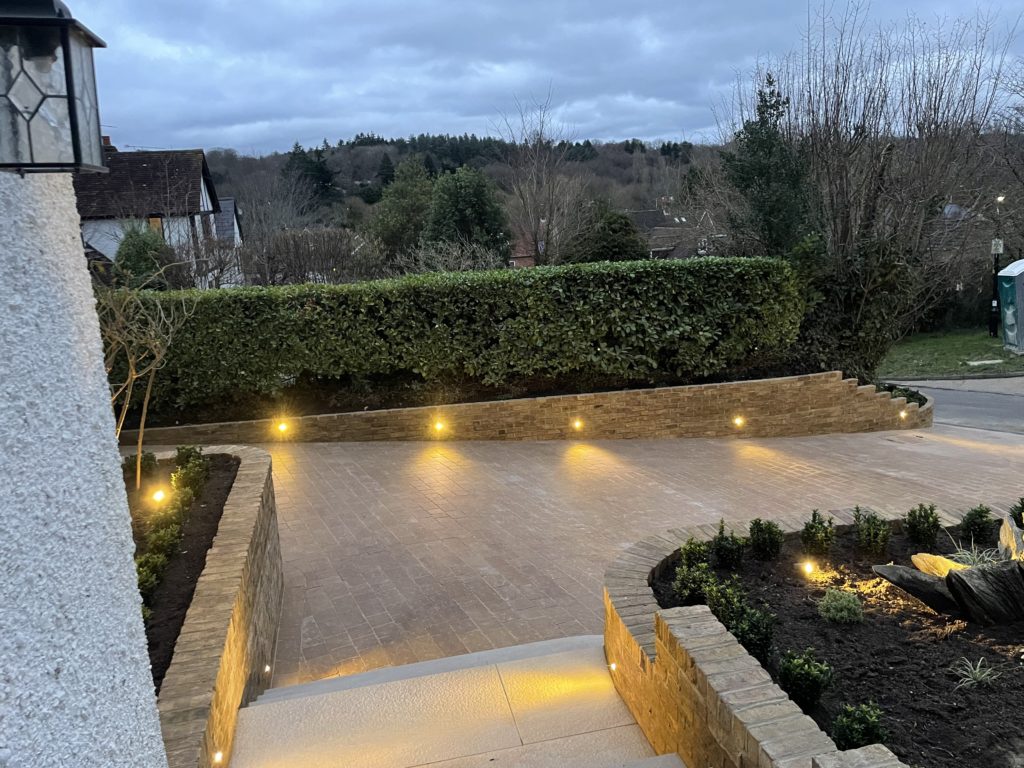
People often think about garden design as something that happens behind the house, yet the front garden creates the first relationship between the property and everyone who arrives there. Our Gerrards Cross project required us to reconsider that arrival completely, because the existing frontage did not make the most of either the house or the available space.
The usable driveway area increased substantially, although providing additional parking was only one part of the exercise. Retaining walls, steps, planting, handrails and lighting all needed to sit comfortably with the driveway, and the construction beneath those elements required the same level of attention as the surfaces people would eventually see.
A considerable amount of excavation, foundation work and masonry therefore sits behind the completed frontage. Nevertheless, visitors do not arrive wondering about the volume of material removed from site, because the finished impression comes from the way the proportions, planting, lighting and hard landscaping work together.
That contrast is worth remembering when comparing professional landscaping quotations. Much of the work that determines whether a landscape performs properly disappears beneath the finished garden, yet it is precisely that work which allows the attractive parts above ground to remain attractive.
Why combine garden design and professional landscaping?
There are several perfectly valid ways to commission a new garden, and employing an independent garden designer before tendering the construction to separate landscapers can work very well. Our approach is different because we can take responsibility for both the creative design and the professional landscaping required to turn that design into a finished garden.
Designing with construction knowledge changes the decisions we make at an early stage. Materials are considered alongside the way they will weather and be installed, levels are developed with an understanding of how they will work on site, and structural details, drainage, planting and access can influence the drawing before anybody begins construction.
The same connection becomes particularly useful once work begins, because real gardens occasionally reveal something that no drawing or survey could have predicted. Instead of passing the problem between designer and contractor, we can consider the practical issue alongside the original design intention and develop a solution that preserves both.
For the homeowner, that continuity also makes responsibility much clearer. One team can understand the garden from the first design conversations through construction, planting and completion, while the original idea remains present throughout the process rather than becoming diluted as the project passes between different companies.
What should you budget for a professionally designed and landscaped garden?
Every garden carries a different combination of requirements, which makes a universal square-metre price particularly unhelpful when discussing complete landscape projects. Access, excavation, changes in level, retaining structures, drainage, paving, decking, lighting, planting and the amount of material that needs moving can all alter the cost before we even consider the size of the garden.
Nevertheless, homeowners need some indication of whether the type of work we undertake fits the investment they have in mind. Most complete garden transformations that we now design and construct represent an investment from around £30,000, while larger gardens and projects involving substantial engineering, structures or premium materials can extend considerably beyond that figure.
I do not regard £30,000 as an arbitrary line drawn across every enquiry, because a smaller, beautifully considered garden may require a very different level of construction from a large site with retaining walls, drainage and extensive groundworks. What matters is whether the ambition for the garden, the nature of the property and the available investment sit comfortably together.
For that reason, the first conversation is much more useful when it focuses on what you would like to change and how you hope to use the finished space. Once we understand those priorities, we can establish whether the garden you are imagining and the budget available have a sensible chance of becoming the same project.
Your garden does not need to follow somebody else’s formula
Buckinghamshire and the Chilterns contain an enormous variety of homes, from contemporary architecture and recently extended family houses to period properties surrounded by landscapes that have developed over generations. It would make very little sense to approach all of those gardens with the same collection of fashionable materials, familiar shapes and predetermined features.
The house, existing trees, aspect, views, boundaries and changes in level already provide part of the design brief, while the people living there provide the rest. A family who entertains regularly may need a generous terrace and outdoor kitchen, whereas another client may value privacy, planting, somewhere quiet to read and a beautiful view through the kitchen doors far more highly.
Good garden design brings those requirements together without making the result feel as though somebody worked through a checklist. The finished garden should feel comfortable enough that, once it has matured, many of the decisions behind it appear almost inevitable.
That apparently effortless result normally requires a considerable amount of thought. However, when the design, materials, planting and construction all respond to the same idea, the garden begins to feel as though it genuinely belongs to the property rather than having been installed around it.
Considering garden design and landscaping in Buckinghamshire?
If you are beginning to think seriously about redesigning your garden, you do not need to arrive at the first conversation with a completed brief or a collection of finished answers. In many cases, understanding what currently frustrates you, what you enjoy about the property and how you would like to spend time outside gives us a far more useful starting point.
Karl Harrison Landscapes designs and builds gardens around Amersham, Chalfont St Giles, Gerrards Cross, Beaconsfield and the surrounding Buckinghamshire and Chilterns area. Our work ranges from carefully considered smaller spaces to substantial complete landscapes, although the aim remains the same: to create a garden that works properly, feels appropriate to its setting and gives its owners considerably more reason to use it.
If you have a garden that deserves more thought than simply replacing the paving or adding another feature, tell us a little about the property and what you would like to change. We can then begin considering what your garden could become, rather than trying to make it look like somebody else’s.
Tell us about your garden
If you are considering a professionally designed and landscaped garden, send us a few details about your property, where you are located and what you would like the garden to achieve. Photographs are always useful at this early stage, and an indication of the level of investment you are considering helps us give you a meaningful response rather than an unrealistic one.
You do not need to know exactly what the solution should be before getting in touch, because developing that solution is part of the design process. What matters initially is that you are ready to explore the possibilities and create a garden that deserves to belong to your home.